Secondary Sanctions in 2026: How the US Can Block Your Bank in Turkey, UAE, or China



Key Insight (TL;DR)
"EO 14024 and EO 14114 give the US authority to place any foreign bank on the SDN list for facilitating 'significant transactions' supporting Russia's military-industrial base. Banks in Turkey, UAE, and China are dramatically tightening KYC in 2026. Onex pre-clears every transaction across OFAC, EU, and UK lists — screening the full graph before funds move."
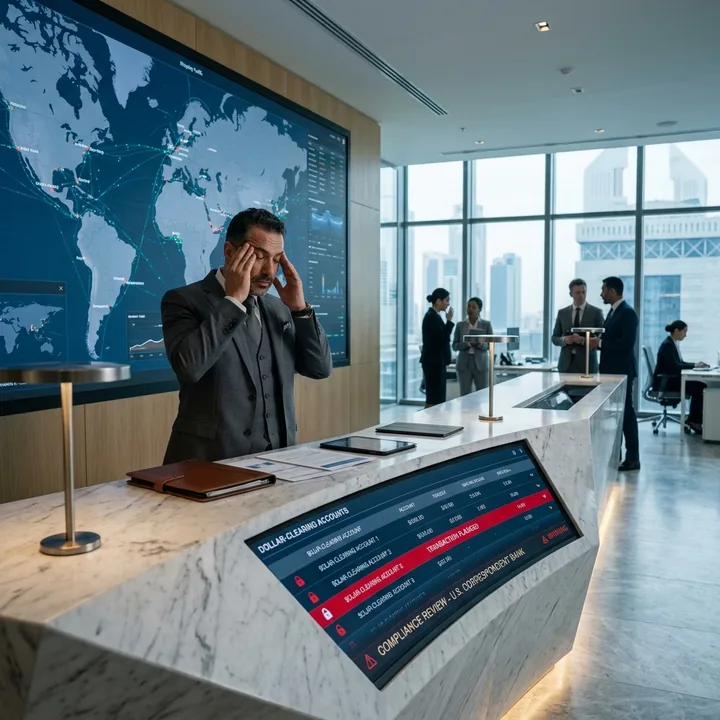
Most international treasury teams think of US sanctions as something that happens to Russian banks, Russian oligarchs, or specifically named entities on the OFAC SDN list. That mental model is dangerously incomplete in 2026. The real enforcement frontier has shifted — and the institutions now at risk are the ones your business relies on every day: your Turkish correspondent, your UAE payments processor, your Chinese clearing house. Under the authority of Executive Order 14114, the United States can cut any of them off from the US dollar system, not for being Russian, but simply for doing business with the wrong counterparty at the wrong moment.
This is the mechanics of secondary sanctions — and understanding them is now a core treasury competency for any business operating in emerging-market payment corridors.
Section 1: What EO 14024 and EO 14114 Actually Do
Executive Order 14024, signed in April 2021, gave the US Treasury broad authority to sanction individuals and entities — including foreign ones — operating in strategic sectors of the Russian economy. That was a significant expansion of enforcement reach. But it was Executive Order 14114, issued in December 2023, that changed the landscape for international banks.
EO 14114 extended and sharpened the secondary sanctions architecture by explicitly authorising OFAC to place foreign financial institutions on the SDN list if they are found to have facilitated "significant transactions" for Russia's military-industrial base. The critical word is foreign. A bank does not need to be Russian, Russian-owned, or even Russia-facing to be sanctioned. It needs only to have been a meaningful node in a payment chain that ultimately supported designated Russian entities or the sectors they operate in.
The practical implication is stark. A bank in Istanbul that processes a trade finance payment for a Turkish industrial supplier — one whose goods subsequently appear in a Russian defence procurement network — is, under this authority, potentially subject to a full SDN designation. That means immediate disconnection from US dollar correspondent banking, the effective end of its ability to participate in global trade finance, and cascading consequences for every client it serves.
Section 2: Why Turkey, UAE, and China Are the Current Flashpoints
When primary sanctions cut Russian banks out of the SWIFT-connected Western financial system, payment flows did not disappear — they rerouted. Turkey, the UAE, and China became the principal intermediary jurisdictions, handling enormous volumes of Russia-linked trade settlement. For a period, this worked. But it also placed the financial institutions in those countries squarely in OFAC's field of view.
By early 2026, the data tells a clear story:
- Turkish banks dramatically increased KYC rejection rates on payments with any Russia-linked provenance, with multiple major lenders issuing internal directives to exit entire client segments rather than risk USD correspondent designation.
- UAE-based financial institutions, including some of Dubai's largest international banks, introduced multi-stage enhanced due diligence (EDD) protocols that can hold Russia-adjacent payments in review for weeks — or reject them entirely.
- Chinese state-affiliated banks quietly curtailed Russia-linked dollar clearing services following informal US Treasury engagement, a shift that had profound consequences for businesses that had relied on renminbi-clearing workarounds.
These are not sanctions themselves. They are pre-emptive self-protection by institutions that understand, precisely, what secondary designation would mean for their business model. The message to their corporate clients is unambiguous: payments that look ambiguous will be rejected, and accounts that generate too many ambiguous payments will be closed.
Section 3: The Enforcement Graph — How OFAC Maps Entire Commercial Ecosystems
The most consequential evolution in US sanctions enforcement in recent years is not a new executive order. It is a new methodology: network-based enforcement.
Traditional sanctions enforcement focused on named entities — the SDN list identified specific persons, companies, and banks. Modern OFAC enforcement operates on a graph model. Analysts map the full commercial ecosystem around a sanctioned entity: its suppliers, its logistics providers, its freight forwarders, its customs brokers, and critically — the banks that serve each of those nodes.
This means that a payment entirely between non-sanctioned parties can still trigger enforcement action if, when mapped, it forms part of a supply chain that terminates at a designated entity. The question OFAC is asking in 2026 is not merely "Is the counterparty sanctioned?" It is: "Does this transaction, in context, facilitate the operations of Russia's military-industrial base?"
The red flags that OFAC's current enforcement guidance highlights include:
- Sudden or unexplained changes in shipping routes — particularly rerouting through third-country jurisdictions that were not previously used
- Payments originating from jurisdictions unrelated to the stated trade — funds arriving from a UAE entity for goods ostensibly shipped between a Chinese supplier and a Turkish buyer
- Vague or inconsistent end-user certificates — documentation that cannot definitively establish where goods will be used or by whom
- Shell company ownership structures — beneficial ownership that runs through multiple layers with no clear legitimate commercial rationale
- Goods categories that match controlled-technology watchlists — electronics, precision components, industrial machinery, and other dual-use categories that feature in Russia's documented procurement patterns
A single payment that carries several of these characteristics is sufficient to flag not just the transaction, but the entire corporate account — and potentially the bank that processed it.
Section 4: The Cost of a False Step — Correspondent Banking Exclusion
It is worth being precise about what secondary sanctions designation actually means for a bank, because the severity is often underestimated.
When a foreign financial institution is placed on the OFAC SDN list under the secondary sanctions authority, it loses access to US dollar correspondent banking. This is not a fine, not a warning, not a temporary suspension. It is a permanent severing of the institution's ability to clear US dollar transactions through any US-regulated correspondent bank. Since the US dollar remains the dominant currency of global trade finance — accounting for the majority of commodity pricing, shipping contracts, and international credit facilities — this is an existential event for most banks.
The institution cannot process international trade payments. It cannot issue letters of credit. It cannot participate in dollar-denominated syndicated lending. Its corporate clients lose access to all of these functions simultaneously. Even clients with no Russia-linked activity whatsoever are caught in the blast radius, because their bank can no longer serve them.
This is why even the threat of secondary sanctions designation has been enough to reshape banking behaviour across Turkey, UAE, and China. The asymmetry is severe: the cost of processing a Russia-linked payment that triggers OFAC attention vastly outweighs any revenue that payment could generate.
Section 5: What Compliant B2B International Payments Look Like in 2026
For treasury teams and procurement officers navigating this environment, the compliance standard has risen considerably. Standard transaction screening — checking counterparty names against a single sanctions list — is no longer sufficient. The enforcement graph demands a graph-level response.
Effective compliance in 2026 means:
- Multi-list, real-time screening against OFAC SDN, EU consolidated list, UK HMT financial sanctions, and relevant national lists simultaneously — not sequentially
- Counterparty network analysis — not just the immediate payee, but their known beneficial owners, associated entities, and flagged commercial relationships
- Logistics chain verification — the freight forwarder, customs broker, and logistics provider involved in the underlying trade are all nodes that require screening
- Correspondent path validation — the banks that will handle the payment en route must themselves be clear of designation or elevated risk status
- End-user documentation review — ensuring that goods documentation is specific, consistent, and credible before a payment is released
Doing this manually, for high volumes of international B2B transactions, is practically impossible without purpose-built compliance infrastructure.
Section 6: How Onex Eliminates Secondary Sanctions Exposure
Onex was built for exactly this compliance environment. Our platform simultaneously pre-clears every transaction against OFAC, EU, and UK sanctions lists before funds are committed. But pre-clearance at the counterparty level is only the starting point.
Our full transaction graph screening examines every node in the payment: the counterparty, their beneficial ownership chain, the logistics provider involved in the underlying trade, the customs and freight entities named in supporting documentation, and the correspondent banking path the funds will travel. If any node in that graph carries elevated risk — whether through direct listing, ownership linkage, or pattern-based flagging — the transaction is held for compliance review before it moves.
This is not a bolt-on compliance layer. It is the core of how Onex processes international B2B payments. The result is that our clients operate with zero false-flag rate — payments that are genuinely compliant clear without delay, and payments that carry real exposure are caught before they create liability.
For businesses in Turkey, UAE, China, and other jurisdictions where secondary sanctions risk is now a daily operational reality, Onex provides the compliance infrastructure that allows legitimate international trade to continue — without putting your banking relationship, or your bank's banking relationship, at risk.
If your current payment provider cannot tell you, in real time, how every transaction has been screened and what the full graph looks like — that is a gap that secondary sanctions enforcement will eventually find. Contact Onex today to understand what compliant international B2B payments look like for your business.
References & External Insights
-
OFAC — Secondary Sanctions and Foreign Financial Institutions Guidance: :
-
US Treasury — Executive Order 14114 (December 2023) Press Release and Text: :
-
European Banking Authority — Guidelines on ML/TF Risk Factors Including Sanctions Evasion: :
-
Bank for International Settlements / FSB — Report on Correspondent Banking and De-risking: :
-
Baker McKenzie — Russia Sanctions: Secondary Sanctions Risk for Third-Country Entities: https://www.bakermckenzie.com/en/insight/publications/2024/01/russia-sanctions-secondary-risk-third-country
How does ONEX CRM work?
ONEX ensures secure cross-border payments and KTS defense.
Related Insights
Compliance & Routing Risk Engine
Evaluate regulatory viability, secondary sanctions risk, and projected clearing speed for your specific B2B trade corridor in 3 clicks.
Shield Contracts from Customs Fines
AI-powered invoice & HS code pre-audit to eliminate customs value adjustments.
Trade Compliance & Customs Pre-Audit
Mitigate bank account hold-ups and customs value adjustments with automated AI pre-screening.



Related Insights
All
AML Compliance Engineering: Building Audit-Ready Transaction Trails in Global Trade

Swift to Set New Rules for Retail Cross-Border Payments on Its Network in Bold Move to Further Ramp up Speed and Predictability: AML Compliance Engineering: Building Audit-Ready Transaction Trails in Global Trade
